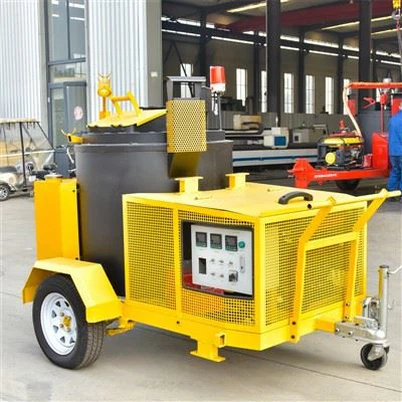
What is the maximum grouting distance of a Traction Grouting Machine?
Leave a message

When it comes to the operation of a Traction Grouting Machine, one of the most frequently asked questions is about its maximum grouting distance. As a supplier of Traction Grouting Machines, I have encountered this query numerous times from our clients. In this blog post, I will delve into the factors that influence the maximum grouting distance and provide a comprehensive understanding of this crucial aspect of our machines.


Understanding the Traction Grouting Machine
Before we discuss the maximum grouting distance, it's essential to understand what a Traction Grouting Machine is and how it functions. A Traction Grouting Machine is a specialized piece of equipment used in various construction and infrastructure projects. It is designed to inject grout, which is a mixture of cement, water, and sometimes additives, into the ground or structures to fill voids, stabilize soil, or strengthen foundations.
The machine is typically equipped with a powerful pump that can generate high pressure to force the grout through a pipeline and into the target area. The traction feature allows the machine to be moved easily along the project site, ensuring efficient and precise grouting operations.
Factors Affecting the Maximum Grouting Distance
Several factors play a significant role in determining the maximum grouting distance of a Traction Grouting Machine. Let's take a closer look at each of these factors:
1. Pump Pressure and Capacity
The pump is the heart of the Traction Grouting Machine, and its pressure and capacity are crucial factors in determining the maximum grouting distance. A high-pressure pump can generate the force required to push the grout through the pipeline over a longer distance. The capacity of the pump, measured in liters per minute or gallons per minute, also affects the grouting distance. A pump with a higher capacity can deliver more grout in a shorter period, allowing for faster and more extensive grouting operations.
2. Grout Properties
The properties of the grout, such as its viscosity, density, and particle size, can significantly impact the maximum grouting distance. Grout with a lower viscosity flows more easily through the pipeline, allowing it to reach a greater distance. On the other hand, grout with a higher density or larger particle size may require more pressure to pump and may not travel as far.
3. Pipeline Diameter and Length
The diameter and length of the pipeline used for grouting also affect the maximum grouting distance. A larger diameter pipeline offers less resistance to the flow of grout, allowing it to travel further. However, increasing the diameter of the pipeline also increases the volume of grout required to fill it, which can be a limiting factor. The length of the pipeline is another important consideration. As the length of the pipeline increases, the resistance to the flow of grout also increases, reducing the maximum grouting distance.
4. Friction and Resistance
Friction and resistance within the pipeline can also limit the maximum grouting distance. The internal surface of the pipeline, as well as any bends, elbows, or fittings, can cause friction and resistance to the flow of grout. To minimize these effects, it is important to use a smooth and straight pipeline and to avoid sharp bends and fittings whenever possible.
5. Ground Conditions
The ground conditions at the project site can also have a significant impact on the maximum grouting distance. In loose or porous soil, the grout may spread more easily, allowing it to reach a greater distance. However, in dense or compacted soil, the grout may encounter more resistance, reducing the maximum grouting distance.
Calculating the Maximum Grouting Distance
Calculating the maximum grouting distance of a Traction Grouting Machine is a complex process that requires considering all of the factors mentioned above. In general, the maximum grouting distance can be estimated using the following formula:
[ D = \frac{P \times A}{\mu \times L \times f} ]
Where:
- ( D ) is the maximum grouting distance
- ( P ) is the pump pressure
- ( A ) is the cross-sectional area of the pipeline
- ( \mu ) is the viscosity of the grout
- ( L ) is the length of the pipeline
- ( f ) is the friction factor
However, it's important to note that this formula provides only an estimate, and the actual maximum grouting distance may vary depending on the specific conditions at the project site.
Real-World Examples
To better understand the maximum grouting distance of a Traction Grouting Machine, let's take a look at some real-world examples.
In a recent project, we supplied a Traction Grouting Machine to a construction company for a foundation stabilization project. The project site had relatively loose soil, and the grout used had a low viscosity. The machine was equipped with a high-pressure pump and a 50mm diameter pipeline. With these specifications, the machine was able to achieve a maximum grouting distance of up to 50 meters.
In another project, a Traction Grouting Machine was used for soil improvement in a compacted soil area. The grout used had a higher viscosity, and the pipeline diameter was 32mm. Despite the challenging ground conditions, the machine was still able to achieve a maximum grouting distance of approximately 30 meters.
Importance of Choosing the Right Traction Grouting Machine
Choosing the right Traction Grouting Machine is crucial to ensure efficient and effective grouting operations. When selecting a machine, it's important to consider the maximum grouting distance required for your project, as well as the other factors mentioned above.
At our company, we offer a wide range of Traction Grouting Machines with different pump pressures, capacities, and pipeline diameters to meet the diverse needs of our clients. Our machines are designed to provide high performance, reliability, and ease of use, ensuring that you can achieve the maximum grouting distance required for your project.
In addition to Traction Grouting Machines, we also offer other related products, such as the 120L Asphalt Crack Sealing Machine, Joint Filling Machine, and Used Crack sealing Machine. These products are designed to complement our Traction Grouting Machines and provide a comprehensive solution for your construction and infrastructure projects.
Contact Us for More Information
If you have any questions about the maximum grouting distance of our Traction Grouting Machines or would like to discuss your specific project requirements, please don't hesitate to contact us. Our team of experts is always ready to provide you with the information and support you need to make an informed decision.
Whether you're a contractor, engineer, or project manager, we can help you choose the right Traction Grouting Machine for your project and ensure that you achieve the best results. Contact us today to start the conversation and take the first step towards a successful grouting project.
References
- "Grouting Technology Handbook" by John P. Carter
- "Soil Improvement and Ground Modification" by Robert D. Holtz
- "Construction Equipment Handbook" by Frank R. Driscoll