What are the differences in road joint filling for curved and straight roads?
Leave a message

Hey there! As a road joint filling supplier, I've seen my fair share of road projects, and one question that often comes up is: What are the differences in road joint filling for curved and straight roads? Well, let's dive right in and break it down.
1. Geometric Considerations
First off, the geometry of curved and straight roads is obviously different. On a straight road, the joints are usually laid out in a pretty straightforward pattern. They're often parallel to the direction of traffic, and the alignment is consistent. This makes it easier to plan and execute the joint - filling process.
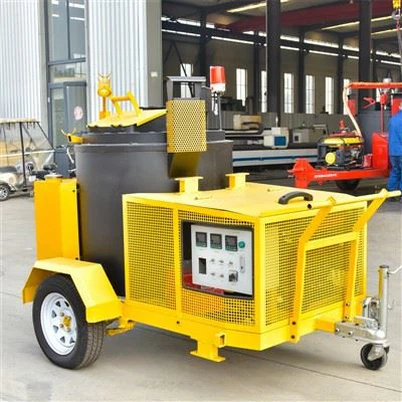
For example, when using our Asphalt Crack sealing Machine, on a straight road, the operator can move in a linear path. The machine can be set to a constant speed and filling rate, as the conditions along the joint remain relatively stable. The operator doesn't have to worry too much about sudden changes in the joint's direction.
On the other hand, curved roads present a whole new set of challenges. The joints on a curved road follow the curvature of the road. This means that the direction of the joint is constantly changing. When filling these joints, the operator has to be much more precise. They need to adjust the machine's direction continuously to follow the curve. Our Fully Automatic Seam Sealing Machine can be a great help here, as it has advanced controls that can be programmed to follow a curved path more accurately.
2. Stress and Movement
Another major difference lies in the stress and movement that the joints experience. Straight roads generally have more predictable stress patterns. The traffic load is mainly distributed in a linear direction, and the expansion and contraction of the road surface due to temperature changes are more uniform. This means that the joint filler only needs to withstand relatively consistent forces.


In contrast, curved roads are subject to more complex stress. The centrifugal force generated by vehicles moving along the curve puts additional stress on the outer edge of the curve. This can cause the joints on the outer part of the curve to experience more movement and stress compared to those on the inner part. As a result, the joint filler for curved roads needs to be more flexible and durable. Our 120L Asphalt Crack Sealing Machine can be used to apply a special type of joint filler that is designed to handle these increased stresses.
3. Filling Techniques
The filling techniques also vary between curved and straight roads. On straight roads, a continuous and uniform filling process is often sufficient. The operator can start at one end of the joint and move to the other, maintaining a consistent flow of the joint - filling material.
For curved roads, however, the filling process may need to be more segmented. Since the joint's direction is changing, it might be necessary to fill the joint in smaller sections to ensure that the filler is applied accurately. This requires more skill from the operator, as they need to start and stop the filling process at the right times to avoid gaps or over - filling.
4. Material Selection
The choice of joint - filling material is crucial, and it can be different for curved and straight roads. For straight roads, a standard joint - filling material that provides good adhesion and basic flexibility is usually sufficient. These materials are often more cost - effective, as they don't need to meet the same high - performance requirements as those for curved roads.
Curved roads, on the other hand, demand a high - quality joint - filling material. The material needs to be able to stretch and contract with the movement of the joint caused by the complex stress patterns. It should also have excellent adhesion to prevent it from coming loose due to the additional forces. We offer a range of materials that are specifically formulated for curved roads, and our team can help you choose the right one for your project.
5. Safety Considerations
Safety is always a top priority in road construction. On straight roads, the work area is more straightforward to set up. The traffic can be diverted in a linear pattern, and the workers have a clear view of the oncoming traffic.
On curved roads, setting up the work area is more challenging. The curvature of the road can limit the visibility of workers and oncoming traffic. Extra safety measures need to be taken, such as placing more warning signs and using traffic control devices to ensure that both workers and drivers are safe.
Why Choose Us as Your Road Joint Filling Supplier?
We understand all these differences between filling joints on curved and straight roads. Our machines are designed to handle the unique challenges of each type of road. Whether you're working on a long - stretch straight highway or a winding mountain road, we've got the right equipment and materials for you.
Our team of experts has years of experience in the road joint filling industry. We can provide you with technical support and advice on the best practices for your project. We also offer training for your operators to ensure that they can use our machines effectively and safely.
If you're looking for a reliable road joint filling supplier, we'd love to hear from you. Whether you have questions about our products, need a quote, or want to discuss a specific project, don't hesitate to reach out. We're here to help you get the job done right.
References
- "Principles of Highway Engineering and Traffic Analysis" by Fred L. Mannering, Scott S. Washburn, and Vikash V. Vardhan
- "Pavement Design and Material" by H. E. Davis and W. R. Christensen