What are the specifications for the width of China road joints during filling?
Leave a message

As a leading supplier of road joint filling products in China, I've been deeply involved in the industry for years. One of the most frequently asked questions from our clients is about the specifications for the width of China road joints during filling. In this blog, I'll share some in - depth knowledge on this topic.
General Considerations for Road Joint Width
The width of road joints is a critical factor in the road joint filling process. Different types of roads, such as highways, urban roads, and industrial roads, have different requirements for joint width. In China, the design of road joint width is mainly based on factors like traffic volume, climate conditions, and the type of road surface materials.
For highways, where the traffic volume is high and the vehicles are often heavy - duty, the joint width needs to be carefully determined. Generally, the width of expansion joints on highways can range from 20mm to 40mm. This relatively wide width is designed to accommodate the thermal expansion and contraction of the road surface caused by temperature changes. During the hot summer months, the asphalt or concrete road surface will expand. A wider joint can prevent the road surface from cracking due to the lack of expansion space. On the other hand, in cold winter, the road surface contracts, and the wide joint can still maintain its integrity.
Urban roads, especially those in the central business districts, have different joint width requirements. The traffic on urban roads is more complex, with a mix of cars, buses, and bicycles. The joint width for urban roads usually ranges from 15mm to 30mm. This width is a balance between the need for expansion and contraction and the comfort of vehicle and pedestrian passage. Narrower joints can reduce the risk of small objects getting stuck in the joints, which could potentially cause damage to vehicles or pose a tripping hazard to pedestrians.
Industrial roads, which are often used for heavy - load transportation within factories or industrial parks, may have wider joints. The joint width for industrial roads can be between 25mm and 50mm. The heavy - duty vehicles in industrial areas exert greater pressure on the road surface, and a wider joint can better withstand the stress caused by these vehicles.
Impact of Climate on Joint Width
China has a vast territory with diverse climate conditions. In regions with large temperature differences between seasons, such as the northern part of China, the joint width needs to be larger. For example, in Harbin, where the winter temperature can drop to - 20°C or even lower and the summer temperature can reach over 30°C, the expansion and contraction of the road surface are significant. A joint width of 30mm to 40mm is often required to ensure the stability of the road surface throughout the year.
In contrast, in the southern regions of China, where the climate is relatively mild, the joint width can be relatively smaller. In cities like Shenzhen, the temperature variation is not as extreme as in the north. Therefore, a joint width of 15mm to 25mm may be sufficient for most road types.
Filling Materials and Joint Width
The choice of filling materials also affects the joint width. Different filling materials have different properties, such as elasticity, adhesion, and durability.
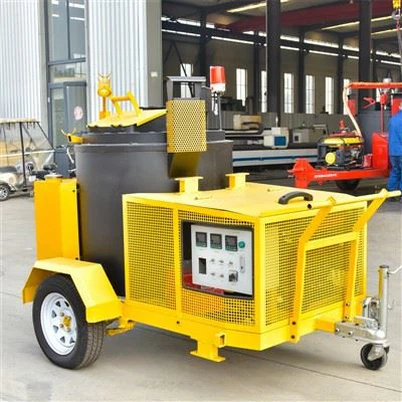
For hot - pour crack sealing materials, which are widely used in China, the joint width should be carefully considered. Hot - pour sealants are known for their good adhesion and durability. When using hot - pour sealants, the joint width should be wide enough to ensure that the sealant can fully fill the joint and form a strong bond with the road surface. For a 32 - Gallon Hot Pour Crack Sealing product, a joint width of at least 12mm is recommended. This width allows the hot - pour sealant to flow freely into the joint and provide effective sealing.
Cold - pour sealants, on the other hand, have different requirements. Cold - pour sealants are usually more flexible but may have lower adhesion compared to hot - pour sealants. For cold - pour sealants, a slightly wider joint width, around 15mm to 20mm, may be needed to ensure proper filling and sealing.
Equipment for Road Joint Filling
The equipment used for road joint filling also has an impact on the joint width. Traction grouting machines and asphalt crack sealing machines are two common types of equipment in the road joint filling industry.
A Traction Grouting Machine is suitable for filling joints of various widths. However, for very narrow joints, the machine may need to be adjusted carefully to ensure accurate filling. Generally, this type of machine can handle joint widths from 10mm to 50mm. The operator can adjust the flow rate and pressure of the filling material according to the joint width.
An Asphalt Crack Sealing Machine is mainly used for sealing asphalt cracks. It is often used for relatively narrow joints, usually between 5mm and 20mm. The machine can heat the asphalt sealant to the appropriate temperature and inject it into the joint precisely.
Quality Control during Filling
During the road joint filling process, strict quality control is essential to ensure that the joint width meets the specifications. Before filling, the joint should be cleaned thoroughly to remove any debris, dust, or loose materials. This step is crucial because any impurities in the joint can affect the adhesion of the filling material and reduce the sealing effect.
After cleaning, the joint width should be measured accurately. If the joint width does not meet the design requirements, appropriate measures should be taken. For example, if the joint is too narrow, it may need to be widened slightly using appropriate tools. If the joint is too wide, additional support or reinforcement may be required to ensure the stability of the filling material.
During the filling process, the filling material should be applied evenly and smoothly. The height of the filling material should be slightly higher than the road surface to compensate for any shrinkage that may occur after the material cools down. After filling, the joint should be protected from traffic and environmental factors until the filling material has fully cured.


Conclusion
In conclusion, the specifications for the width of China road joints during filling are determined by multiple factors, including road type, climate conditions, filling materials, and equipment. As a road joint filling supplier, we understand the importance of these factors and are committed to providing high - quality products and services to meet the diverse needs of our clients.
If you are interested in our road joint filling products or have any questions about road joint filling specifications, please feel free to contact us for further discussion and potential procurement. We are always ready to offer professional advice and solutions to ensure the success of your road construction and maintenance projects.
References
- "Road Design Standards in China", Ministry of Transport of the People's Republic of China
- "Research on Road Joint Filling Technology", Journal of Highway Engineering
- "Guidelines for Road Maintenance and Repair", Local Transportation Departments in China